By Mike Ginter
WE MUST BE THE GREAT ARSENAL OF DEMOCRACY
— President Franklin Delano Roosevelt
When President Roosevelt said these words on December 29, 1940, Americans began to galvanize around the need to fight tyranny and fascism, and the country began to mobilize its industrial might to prepare for World War II. Ultimately, total victory was achieved, the world began to rebuild, and freedom and democracy served as the foundation for nations to expand their economies, push technological boundaries, and generally improve the lives of their citizens. As (World War II) warbird operators and enthusiasts, we have committed our time and treasure to preserve and demonstrate magnificent aircraft that help Americans remember these critical events that shaped our history. The Arsenal of Democracy WWII Victory Capital Flyover was planned to do precisely that – help Americans remember the service and sacrifice of our ‘Greatest Generation’ and consider how their lives have been shaped by men and women who served at home and abroad over 75 years ago. Mike Dale, one of the key organizers of the Arsenal of Democracy Flyover at Culpeper Regional Airport, summarized why it was so important for America, and the world, to remember.
"The Arsenal of Democracy Flight was a reminder of America's exceptionalism. Every nation in history, possessing the military power to rule the world, has attempted to do so with the exception of the United States of America.”
Mike’s perspective hit home with the pilots and crews assembled in the briefing hangar at Culpeper, and it honed a sharper edge of resolve in those participating in this historic commemorative flyover. We all knew we were there to honor the Greatest Generation – it was no about us.
Planning in a COVID Environment
After 18 months of planning and coordination, the week of the Arsenal of Democracy WWII Victory Capitol Flyover had finally arrived. Although 74 aircraft were on the final list of participants, maintenance issues knocked out 8 aircraft, resulting in 66 warbirds arriving at the two staging bases – Culpeper Regional Airport (CJR) and Manassas Regional Airport (HEF). Originally scheduled for May 8, 2020, the Arsenal of Democracy (AOD) Executive Committee postponed the event to September 25 due to Virginia state COVID-19 restrictions – which restricted gatherings to 50 people or less. We needed to safely accommodate around 250 people to accomplish the mission (pilots, marshallers, maintenance crew, airport staff, AOD staff, and registration volunteers), and we needed to host no less than 150 people for the flight briefing. The AOD Executive Committee was laser-focused on accomplishing this flyover in 2020 and we were determined to do it safely and responsibly within the COVID restrictions imposed by the State. Virginia had eased into Phase III by late summer which allowed gatherings of up to 250 people. It would be tight, but we decided to go for it. To plan responsibly under the cloud of the COVID-19 pandemic, we asked the PICs to limit their crews to minimum essential crew for mission execution. We also published the Virginia state restrictions to all registrants to make them aware of the local rules. We procured ample face masks, hand sanitizer, extra hand washing stations, and posted numerous signs to remind participants to practice social distancing. And finally, we developed a simple online COVID-19 screening questionnaire and required each participant to complete this form prior to leaving home base and each morning before they arrived at the airport. (If you had any symptoms, don’t show up!) All of these COVID-precautions were carefully coordinated with the managers and volunteers at both airports. These COVID precautions would only be successful if we could somehow limit the number of public enthusiasts who would certainly want to come to Culpeper and Manassas to see these aircraft. So – we restricted public access to the warbirds at both airports. And thanks to Leah Block (CAF) and her media team, we implemented a plan 1 month prior to the event to limit public attraction at both airports by removing all references to Culpeper and Manassas airport from all marketing materials and websites. We also asked all flight crews to refrain from posting social media announcements that mentioned these airports by name. Our media plan worked, and we did not see a large gathering of local citizenry at both airports (perhaps a few dozen each day at each airport – which was manageable). Our COVID mitigation planning and the cooperation of every participant apparently worked! As I write this exactly 1 month after the scheduled flyover, we have not had any reports from participants or from the 2 airports of any COVID-19 cases related to the AOD. We threaded the “COVID needle” and it worked!
Setting the Stage
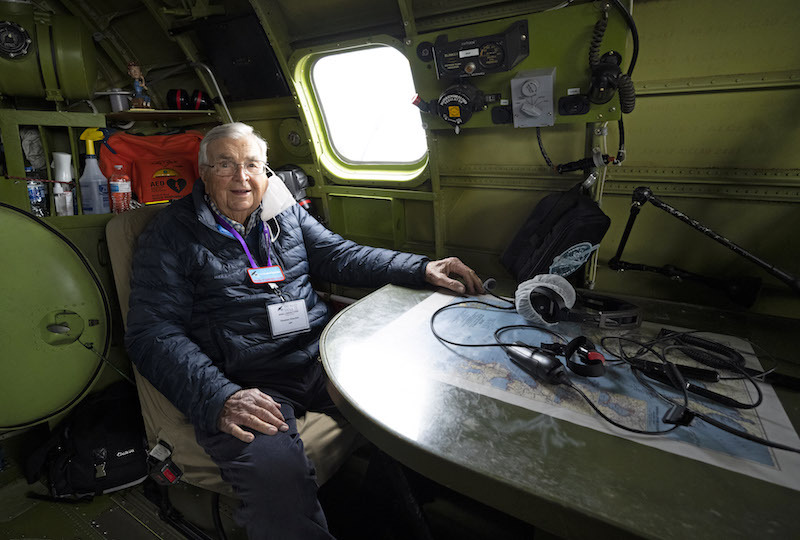 Honorary Airboss, Lt. Col. Bob Vaucher aboard B-29 "Doc" (Dave Tulis)
Our flyover was planned to occur over the National Mall in Washington, DC, which underlies the DC Special Flight Rules Area (SFRA), the Flight Restricted Zone (FRZ), and Prohibited Area 56 (P-56). It also included aircraft in the Standard, Limited and Experimental-Exhibition categories. This meant we had to gain waivers and exemptions to many airspace rules and regulations. Thanks to a very successful flyover in May 2015, we had a good working relationship with the FAA, TSA, U.S. Secret Service, National Park Service, US Capitol Police, US Park Police, and Washington National Airport – each with their own bureaucracies and processes. Each member of the AOD planning team tackled different bureaucracies to get the necessary waivers and exemptions. By mid-September 2020, we had an FAA exemption to fly Experimental category aircraft over the densely populated National Mall and a waiver to fly within 2000 feet laterally of the Washington Monument at 1000 feet AGL, a waiver from the TSA and FAA to enter the FRZ, and permission from the Secret Service, National Park Service and US Capitol Police to fly through Prohibited Area 56. We had the cooperation of the Metro Washington Airport Authority, FAA and all the major Airlines to close Washington National Airport (DCA) for 2 hours on the day of the flyover. And we had coordinated for large teams of TSA and Secret Service agents to conduct security inspections at both airports on the morning of the flyover. We even had authorizations in place to land 2 helicopters at Washington National Airport to support the media and logistics requirements. The AOD team was profoundly grateful to all of our government partners for helping us “work the system” to make this event possible. Special thanks to Congressman Sam Graves for organizing strong bipartisan support for the Flyover, without which we might not have enjoyed the support of so many government agencies. Also special thanks to John Hall, Air Traffic Specialist at Potomac Consolidated Traffic Control Center (TRACON). John dedicated countless hours of planning and assistance to the AOD planners and was the kingpin within the FAA to bring all the right people together. The AOD Executive Committee is also grateful to Tanya Woodward, manager at Culpeper Airport, and Jolene Berry, Deputy Director of Manassas Airport – their “all-in” dedication created a warm and hospitable environment for almost 250 participants to conduct this event. And finally, thank you to our presenting sponsor - the Bob and Delores Hope Foundation and Bob Hope Legacy – as well as all of our sponsors, for their generous support.
As the first aircraft began arriving into Culpeper and Manassas, the weather was perfect, and the forecast for the week was also perfect. Cool, clear skies, unlimited visibility, with light wind – what more could we ask for? On Monday and Tuesday of Flyover week, we completed over 40 sponsor and volunteer appreciation rides in various warbirds. The T-6s flew most of the appreciation rides in 4 and 8 ship formations, and the L-4 Grasshoppers flew many more appreciation rides. By Wednesday, September 23rd, all aircraft and participants were in place. Special thanks to AOPA and their Events planning team, led by Chris Eads, for managing the herculean task of registration, hotel assignments, rental car issuance, meal planning, and credentials for nearly 250 people – their support was invaluable to the AOD and they made it look easy! By Wednesday late afternoon, we completed the first of several air-to-air photo missions with the CAF B-25 “Devil Dog” leading a flight of 4 Texans.
The Plan
So exactly how do you get 66 aircraft from 2 different airports southwest of Dulles International Airport into 28 historically sequenced formations, over the World War II memorial within 1/2 mile of the White House, spaced exactly 2 minutes apart, without violating any of the waivers, without interrupting service to Dulles International Airport and without getting shot down? Simply stated – you build a SIMPLE plan that any warbird pilot can safely execute. To keep the route of flight simple, we planned most of the flyover to follow the Potomac River from Leesburg, VA down to Quantico Marine Corps Air Station. Once we had all the waivers and exemptions in place, the portion of the flyover near Washington, DC was actually the easiest part (if you disregard all the ordinance aimed at you!). The next “easiest” part was navigating near Dulles International Airport without touching their Class B airspace (one of our cardinal rules). This seemed easy by simply remaining below the 1500-foot floor of the Class B while we were over the Potomac River. The FARs allow VFR flight down to 1000 feet AGL, so if we followed the River at 1000 feet, we would remain clear of all Dulles airspace. The River is also NOT densely populated, so even the Experimental aircraft could do this without additional waivers. The hard part of this entire plan to getting the spacing correct over the WWII Memorial (show center). The challenge here was the wide speed difference between all aircraft. The L-4 flight, representing Civil Air Patrol history, zorched along at a blistering 60 knots, while the Stearman’s, Tigermoth, Texans and Harvards (representing the WWII Trainers) mustered 80 to 130 knots. The fighters and bombers were to fly at 165 knots – fast for some, slow for others, but safe and attainable by all. With the goal of perfect 2-minute spacing at show center, we had to stage the slower aircraft close to D.C. and the faster aircraft (which also included the Experimental category aircraft) west of the Dulles Class B airspace over non-densely populated areas. We invented a holding point called LEMAY and placed it over the George Washington Memorial Bridge (where I-495 crosses the Potomac River). The first 6 formations would hold at LEMAY, in 500-foot altitude intervals, and proceed in 2-minute intervals down the Potomac River to show center (9.8 nautical miles). We built 3 other holding points west of the town of Leesburg, VA. We invented the NIMITZ Holding point over the town of Round Hill about 5 miles west of Leesburg, VA, and built a holding stack from 1500 feet to 4000 feet in 500-foot intervals. The floor of Dulles Class B was at 4500 feet directly above NIMITZ hold, so this would work. NIMITZ could only accommodate 6 formations at a time, so we invented 2 other holding points, EISENHOWER and DOOLITTLE, over easily identified VFR checkpoints about 10 miles from NIMITZ. The remaining formations would hold at EISENHOWER and DOOLITTLE in 500-foot altitude intervals. So how do you get the spacing correct at show center with aircraft coming from 4 different holding points, some of which are starting from 38 miles upstream along the Potomac River.
The Flyover was scheduled to begin exactly at 11:30am on Friday, September 25th. That required the first formation to push from LEMAY holding point at exactly 11:20am (L-4’s, 60 knots, 9.8 miles, 1 mile per minute!). Each subsequent formation at LEMAY would descend as lower altitudes were vacated and push at specific time intervals after the preceding formation. The challenge was to connect the first formation coming down the river from NIMITZ with the last formation departing LEMAY without creating a safety hazard and while maintaining a smooth flow of aircraft at show center, where Rob Reider would broadcast his eloquent narration to an international audience. To keep a steady flow of formations flying across show center, the first formation at NIMITZ had to push at exactly 11:21 am. This guaranteed safe separation between aircraft and correct spacing at show center. Every other formation would push from NIMITZ at exactly 2-minute intervals. As the bottom formation pushed from NIMITZ, our friends at Potomac TRACON, with the help of Airboss Wayne Boggs, would “collapse the stack” to ensure each formation was ready to push on time from 1500 feet. As NIMITZ was collapsing, Potomac TRACON would move formations from the top of EISENHOWER to the top of NIMITZ to keep NIMITZ full. As soon as EISENHOWER was empty, Potomac TRACON would move formations from DOOLITTLE to the top of NIMITZ. If Potomac TRACON and Wayne could keep NIMITZ full while collapsing the stack every 2 minutes, we would have a steady stream of formations intercepting the Potomac River and flying beneath the Dulles Class B. With the time, speed and distance figured out from show center all the way back to the Holding points, it was easy to derive the launch sequence plan from each of the host airports. In the end this plan was relatively simple to execute. It took months to develop, and many sets of eyeballs looked at the details while we constantly improved it, but it was easy to understand and execute from a pilot’s perspective.
Practice Day
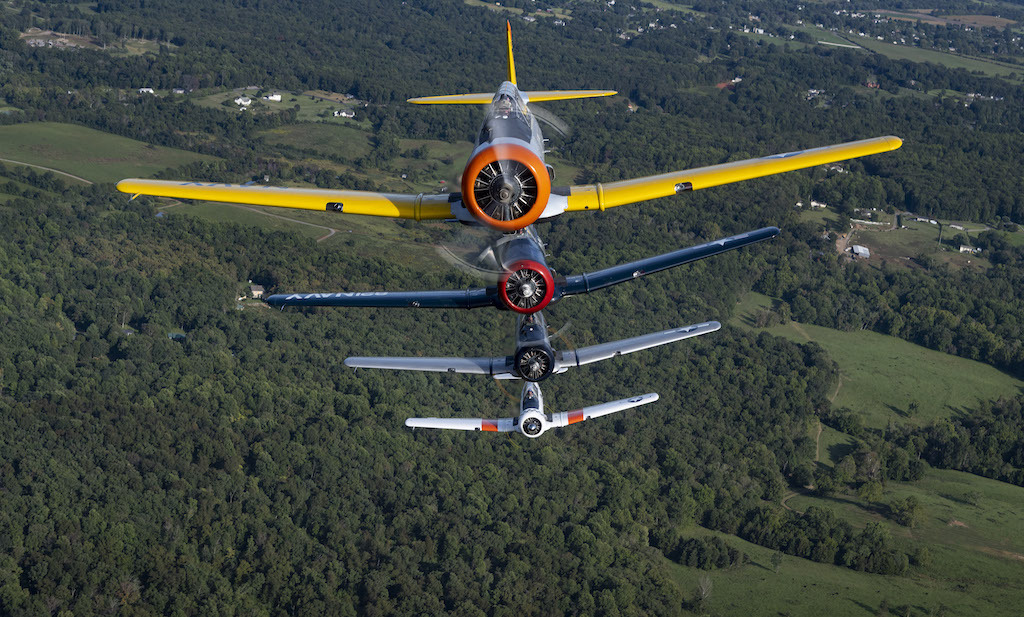 Walt Fricke, Dave Kahley, Jim Koch, Will Loving (Photo: Beth Jenkins)
The Arsenal of Democracy Flyover practice mission occurred on Thursday, September 24th, and would replicate every aspect of the real flyover except no aircraft would enter the DC airspace. The day began with a 5:15am wakeup call to check weather. All observations and forecasts looked great for the whole day, so we were all set. At 6:50am, Rod Moyer took off from Manassas Regional Airport in his DC-3 “Miss Virginia” carrying all the Manassas PICs and SICs and delivered them to Culpeper Airport for the flight briefing at 7:30am. The mission was to rehearse all aspects of the plan, including the launch sequence plan, integrating our Culpeper airboss into the operation, getting the formations flowing safely into and out of the holding points, and making sure the coordination and communications with Potomac TRACON worked as planned. The secondary mission was to capture air-to-air video for eventual use in the AOD videos to be produced after the event. Our media helicopter, an R-66 owned and flown by Ken Pyatt of Sky Helicopters in Dallas, TX, was to capture all the aircraft as they taxied out and took off. Ken probably had the most fun of all the pilots as he raced up and down the side of Culpeper’s runway capturing each formation as they took off. Immediately following the practice mission, Larry Kelley in his B-25 “Panchito” led an air-to-air photo mission and captured formations of Mustangs, C-47s, Corsairs, and both B-29s. Rick Henshaw, piloting his T-6 Texan, led an air-to-air photo mission with the PBY Catalina, owned by the Military Aviation Museum. AOPA provided the photographers and videographers for each of these missions, and the results are available for all to enjoy on YouTube.
The highlight of Thursdays briefing were our guests of honor – 3 World War II veterans – who regaled us with their first-hand accounts of their experiences. Connie Palacioz was one of the original “Rosie the Riveters” and personally riveted many of the rivets on the nose section of both B-29s participating in the Flyover – FIFI and DOC. Paul Hilliard was a Marine Corps gunner on SBD Dauntless Dive Bombers during the war in the Pacific and recounted his experiences of traveling the world and his service. Lt Col Bob Vaucher, USAF (Ret.) was a B-29 pilot with 117 combat missions, most of them in the B-29 in the Pacific theater. Bob picked up the very first B-29 from the Boeing factory in Wichita, KS and led the first large bombing raid over Japan leading over 400 B-29s on that mission. Bob also holds a unique spot in history as the lead planner and pilot of the Show of Force Flyover of the battleship USS Missouri in Tokyo Bay on September 2, 1945 as General Douglas MacArthur signed the instrument of surrender. On that mission, Bob led a massive formation of 525 B-29s as a reminder to the Japanese delegation that the decision to surrender was the right one! Since Bob had experience with large and complex flyovers, the AOD Executive Committee named him the Honorary Airboss for the AOD Flyover – a duty which he accepted and enjoyed immensely. During the practice briefing on Thursday morning, Congressman Sam Graves presented Bob with the FAA Wright Brothers Master Pilot Award and with a brand-new Pilot Certificate which included the Type Ratings of all the bombers Bob flew in the war. At 101 years old, Bob participated in every aspect of the AOD, including the flight briefings, press conference, and a special flight aboard DOC. It was truly special to have Connie, Paul and Bob join us for the flyover.
Thursday’s practice mission was conducted without incident and by all measures was a success – the pilots gained confidence in the plan, the controllers at Potomac TRACON only had minor inputs to the plan, and all but 1 aircraft flew. (Our B-17, Sentimental Journey, suffered a magneto issue and aborted to troubleshoot). There was a palpable sense of excitement at dinner and at the bar that night - all we needed now was the weather to develop as forecasted…
Show Time!
The alarm sounded at 5:15am and the first glimpse of the aviation weather reports was ok – not quite as good as originally forecast but we were on! As Rod Moyer was readying Miss Virginia for the morning ferry flight with the Manassas pilots, I joined the 6:30am “Go/No-Go” call with the interagency folks. This call confirmed the weather was good enough to proceed with the flight briefing and TSA/Secret Service security checks, but the forecast was not perfect, so we decided to gather on the conference line again at 10:00am to make the final Go/No-Go call. This decision point would be informed by a dedicated weather recce flight, piloted by Jim Viola, who would pass a timely PIREP thru Potomac TRACON to me. The flight brief went smoothly, the Manassas pilots returned to Manassas, and the Culpeper crews proceeded through the TSA security check point to their aircraft. At 9:50am, the first aircraft began departing Culpeper while I was on the phone with Potomac TRACON and our weather recce pilot. The weather was great everywhere except over Leesburg Executive Airport and Dulles International, which were both reporting Low IFR with ground fog. Above 1900 feet, the sky was clear, and Jim could see the Washington Monument all the way from the NIMITZ holding point! But below 1900 feet in the Leesburg/Dulles area, it was hard IFR. Jim could not get down to 1500 feet at NIMITZ, and he couldn’t see the Potomac River for at least 10 miles – a key navigational tool for this mission. Our formations would NOT be able to descend to the lowest altitude at NIMITZ, and they would NOT be able to descend to 1000 feet over the River to remain below the Dulles Class B. So, with about 12 aircraft already airborne and heading north, I discontinued the launch, recalled the airborne aircraft, and scrubbed the mission for the day. A tough call, but it was the only call to make. We needed VFR conditions down to 1000 feet over the river and we did not have it. Not that we needed reassurance for this tough call, but the weather a Manassas and Culpeper quickly degraded to IFR right about the time the aircraft would have been returning to their home bases. That would have been a train wreck! That good news is we had a fully coordinated back-up day scheduled for Saturday, September 26th. OK weather – time to improve! We held the Survivor Party that night and a good time was had by all. By the time we were lighting the cigars after the party, the rain was coming down steadily.
The alarm went off at 5:15am for the 3rd consecutive day and the aviation weather apps painted a gloomy picture. Dulles and Washington National were reporting IFR with 500 feet and 700 feet overcast, respectively, and the forecast called for these ceilings to be lower by Noon. I checked several sources for official aviation weather – all said the same thing. Knowing we had a Go/No-Go call to make at 6:30 with the interagency crowd, I called the other members of the Executive Committee to confirm the obvious – this day was not going to see a flyover. We looked at several options, including sliding the event to the afternoon when weather was forecast to improve – that idea gained some traction until we checked with Washington National airport. No dice – they had an arrival bank of airliners scheduled in the afternoon that could not be impacted – this would have rippled throughout the National Airspace System and would not be approved.
While the DC flyover would not happen, we still had a live webcast scheduled for 10am to support, and our media team truly shined while we shifted to a live event with NO live airplanes. John Cudahy and his team of producers pulled off a miracle and the show went on as scheduled. Instead of live flyby video, the team used pre-recorded flight line, take off and air-to-air video to accompany the script. The result was incredible and can be viewed on several online channels.
At 10am, the Culpeper crews gathered in the hangar to watch the live webcast. The weather started to break enough for a few pilots to depart in the afternoon, but most pilots departed on Sunday when the weather improved to VFR. In the end, we appreciated the incredible opportunity to reunite with our warbird friends, fly many formation sorties, and honor 3 members of the Greatest Generation. And the nation got a world class webcast to help them remember the incredible impact World War II.
The parting question by many pilots was “Will we have another Arsenal of Democracy Flyover next year”? My response – write a check for another million bucks and we’ll see!
Video, Images and news Coverage